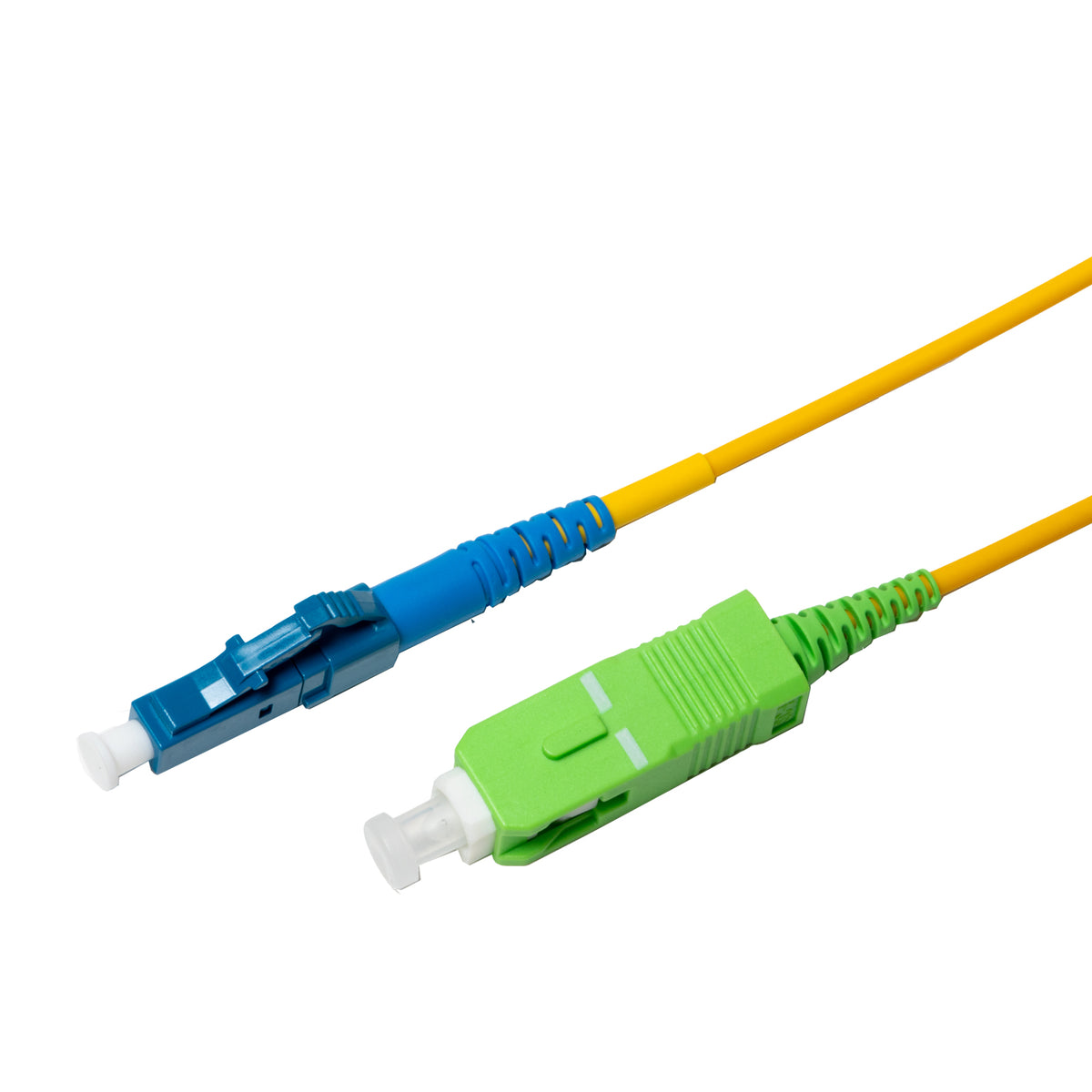
The Right Way to Bridge UPC and APC
UPC end faces are flat, while APC end faces sit at an 8-degree angle. Mating them directly leaves an air gap and misaligned cores. That causes heavy loss and can chip the ferrules. A mixed-polish cord like this one puts the correct polish on each side, so every connection stays physical and clean.
Where Mixed Polish Shows Up
Many PON splitters, fiber distribution hubs, and CATV panels use SC/APC adapters. Meanwhile, switches, media converters, and some test gear use LC/UPC ports. This cord connects them in one step. Lab techs also use it to plug UPC instruments into APC test points.
Color Coding Prevents Mistakes
The SC/APC end comes in green, and the LC/UPC end comes in blue. That visual cue tells installers which port each end belongs in. Before plugging in, always match green to green and blue to blue.
Single Fiber Design
A simplex cord carries one fiber. That suits single-strand services such as GPON, XGS-PON, and BiDi optics, which send and receive on different wavelengths. The slim cable also takes up less room in busy enclosures.
G.657.A1 Fiber
The bend-insensitive fiber handles a 10 mm minimum bend radius with very little added loss. It also mates cleanly with standard single-mode cable. Wall boxes, ONT housings, and splitter trays become much easier to dress.
LSZH Jacket
Low-smoke zero-halogen materials limit smoke and corrosive gases during a fire. This protects people and electronics in enclosed rooms. In US plenum spaces, though, local code still calls for an OFNP rating.
Testing With Mixed-Polish Cords
When testing an APC link with a UPC-ported meter, this cord makes the connection clean. Reference it in your test setup, so its loss isn't counted against the link. Swap in a fresh cord if readings start to drift. Test cords wear out faster than permanent patches, so treat them as consumables.
Care Tips
Clean both ends before every connection, using an APC-rated tool on the green end. Keep the dust caps on whenever the cord is unplugged.