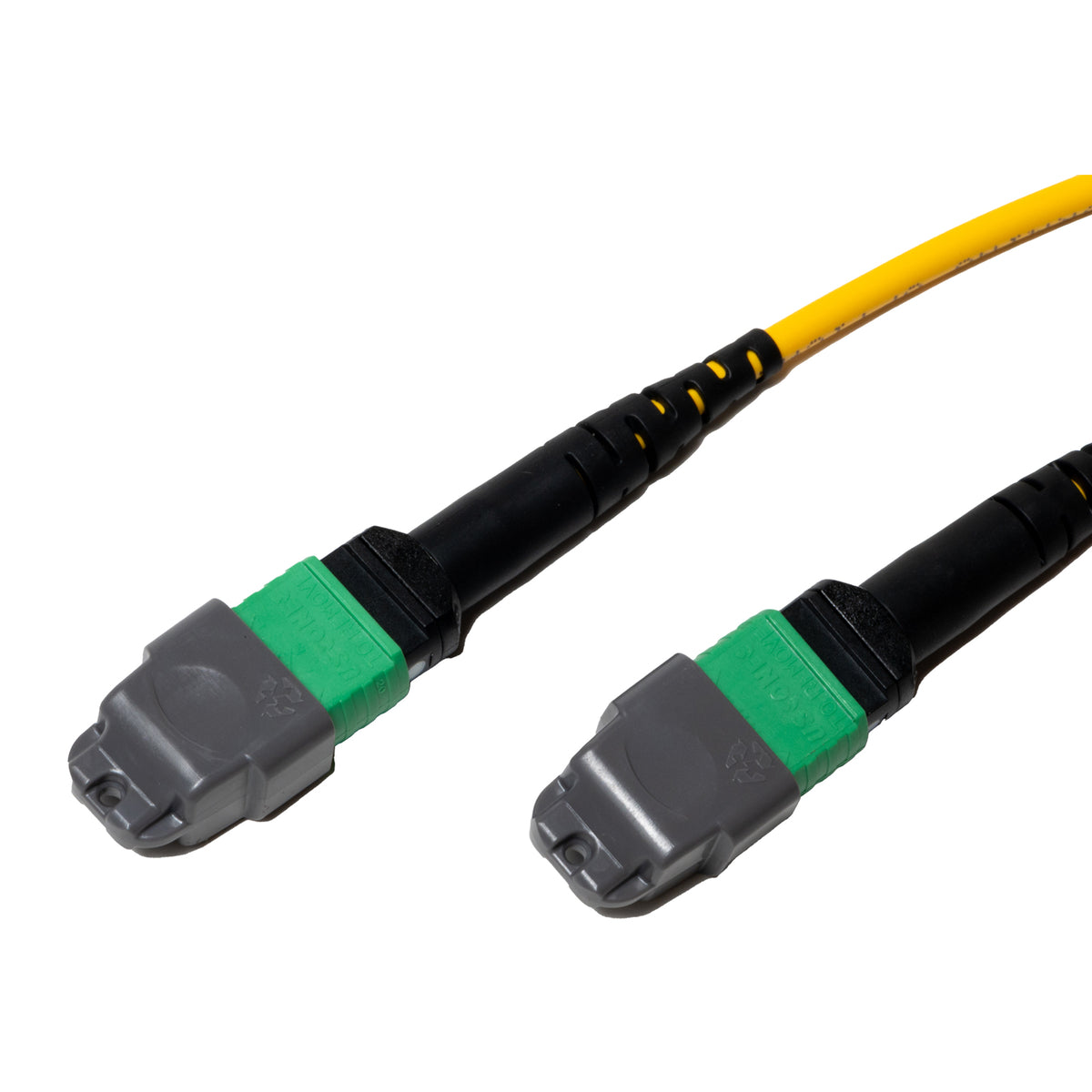
Single-Mode Reach for Bigger Spaces
OS2 fiber uses a tiny 9 µm core that carries light with very little loss. Where multimode starts to struggle past a few hundred meters, OS2 just keeps going. It handles long backbone runs between floors, wings, and buildings on a campus. Distance rarely becomes the limit with this trunk.
Type A for Structured Cabling
Type A wiring maps fiber 1 to fiber 1 straight through, with one key up and one key down. It works neatly with cassettes that break each trunk into six duplex LC ports. You handle polarity at the patch cord level with standard A-to-B jumpers. Each port then follows the same rule, which keeps documentation simple for the next technician.
Elite Low-Loss Performance
Single-mode optics often run on narrow loss budgets, especially through several patch panels. Elite MTP connectors hold insertion loss at 0.35 dB or less per mated pair. That extra margin lets you add cassettes and cross-connects without pushing the link out of spec.
Built to Outlast Upgrades
OS2 glass supports today's 10G and 100G links and the 400G optics coming next. Swap the transceivers at each end when speeds climb, and the trunk in the tray stays put. That's why many designers choose single-mode even for shorter runs.
Yellow Plenum Jacket
TIA-598 assigns yellow to single-mode cable, so anyone opening a tray knows what's inside. The OFNP rating meets NFPA 262 fire and smoke limits for plenum spaces.
Installation Notes
Single-mode MTP connectors typically use an angled polish, so match them with the right cassettes and adapters. Clean every end face before connecting. Keep bends gentle, and never pull the trunk by its connectors.
Where It Fits Best
This trunk is a strong match for links between a main distribution frame and intermediate rooms on other floors. Colocation providers also use single-mode trunks in meet-me rooms, where carriers hand off service. Long data halls with winding tray routes benefit too. A single-mode backbone removes the worry about distance limits once and for all.