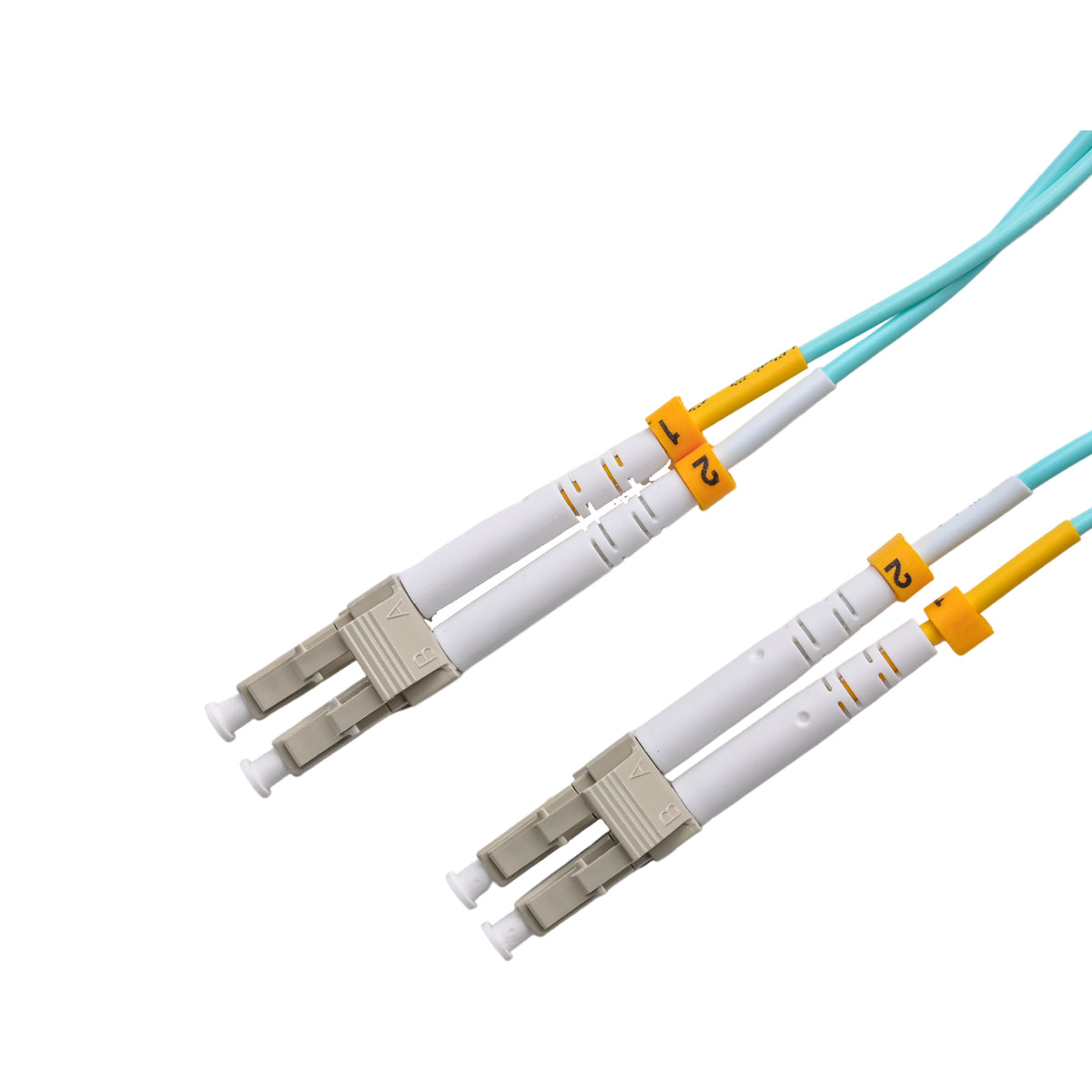
The Data Center Workhorse
LC to LC OM4 is one of the most common fiber cords in modern racks. It connects top-of-rack switches to servers, storage arrays to fabric switches, and switches to LC patch panels. If your network runs 10G or 25G multimode, you'll likely use dozens of these.
OM4 Reach at High Speed
OM4 fiber has the highest modal bandwidth of the common multimode grades. It supports 10GBASE-SR up to about 400 meters and 25GBASE-SR up to about 100 meters. It also carries 40G BiDi optics up to about 150 meters over a single LC duplex pair.
Compact and Dense
LC connectors take up half the space of SC. Their push-pull latch clicks in firmly and releases with a gentle press. That small footprint matters on 48-port switches and high-density panels, where every millimeter counts.
Matching Fiber Grades
OM4 shares its 50 µm core with OM3 and OM5, so these grades connect without a core mismatch. A mixed link performs at the lower grade's level, though. Keep OM4 cords on OM4 runs for full reach, and never connect them to 62.5 µm OM1.
A-to-B Polarity
Each zipcord carries two fibers in A-to-B polarity. Transmit at one switch reaches receive at the other. Some LC connectors allow a quick polarity swap at the clip. Otherwise, simply swap the legs at one end.
Clean Connectors, Stable Links
Dirty end faces cause most multimode link failures. Inspect and clean before every connection, especially on 25G links with tight budgets. A one-click LC cleaner takes seconds.
Planning for Growth
OM4 leaves more headroom than OM3 for future upgrades. Today's 10G links can move to 25G on the same cords and backbone. Many data centers standardize on OM4 for every multimode patch. That keeps inventory simple and avoids mixing grades in one rack.
Jacket Rating
The OFNR jacket meets riser fire ratings for indoor spaces and vertical shafts. Air-handling plenums call for an OFNP-rated cord instead.