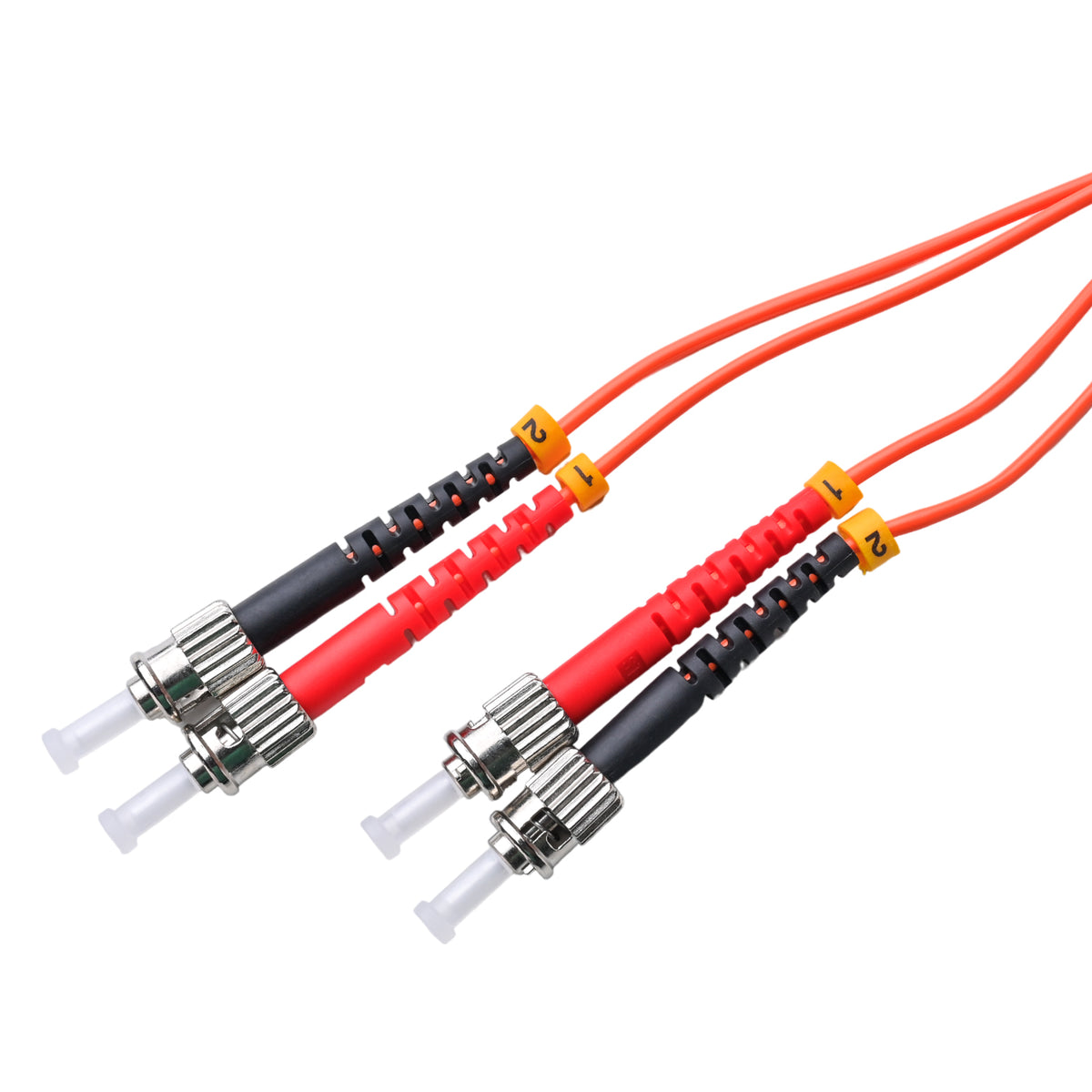
Made for Classic ST Patch Panels
Many schools, hospitals, and industrial sites still run ST-based fiber panels. Swapping them out often isn't worth the downtime. This cord gives you a fresh, factory-terminated replacement for worn or damaged jumpers on those panels.
The Twist-Lock Advantage
ST connectors use a spring-loaded bayonet mount. Push the connector in, turn it a quarter turn, and it locks in place. A key on the body keeps the ferrule aligned. That positive lock resists accidental pulls, which is one reason ST is still popular in industrial and security equipment.
OM1 Performance
OM1 fiber has a 62.5 µm core. It carries 1 Gigabit up to about 275 meters at 850 nm and 100 Mbps Fast Ethernet up to about 2 kilometers at 1300 nm. Many older media converters, cameras, and access control panels run at these speeds and work well on OM1.
Matching the Right Fiber
Keep this cord on 62.5 µm networks only. Connecting it to 50 µm cable adds unnecessary loss and can cause dropped links. The orange jacket helps techs keep the two types apart.
Duplex Construction
Two fibers sit in one 2.0 mm zipcord, so you can split the legs to reach separate ports. Standard A-to-B polarity crosses transmit and receive. If the link doesn't come up, swap the ST legs at one end.
Handling Tips
Turn ST connectors gently when locking and unlocking them. Forcing the bayonet can bend the coupling. Clean end faces before each connection, and keep the orange jacket away from sharp bends.
Where You'll Still Find ST and OM1
This pairing remains common in CCTV backbones, fire alarm networks, and PLC links on factory floors. Older hospitals and university buildings often use it too. Those systems tend to run for decades with few changes. A fresh set of ST jumpers can cure intermittent faults that crept in as the old cords aged.