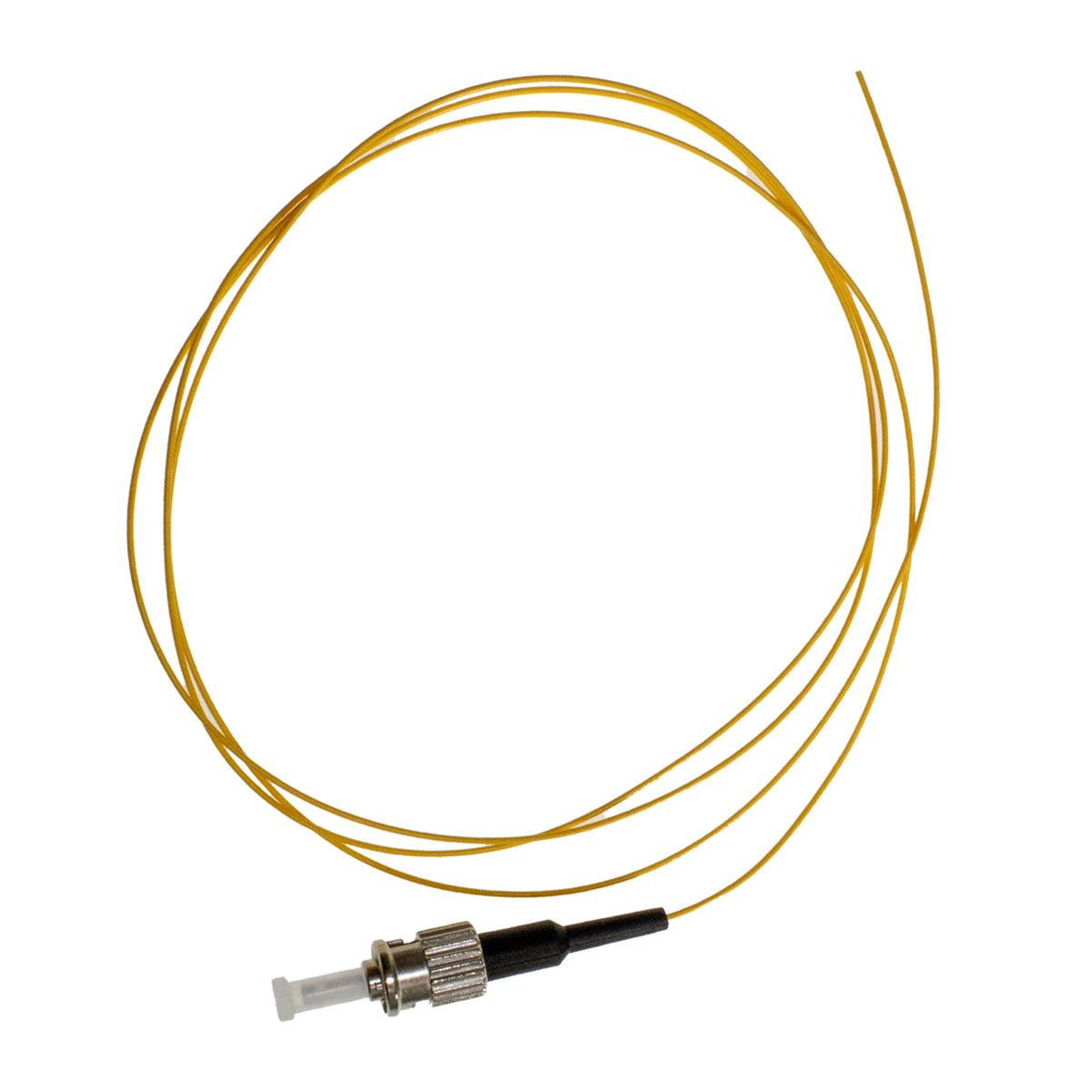
ST Bayonet Coupling
The ST connector uses a spring-loaded, keyed bayonet mount. Push it into the adapter and give it a quarter turn to lock. A long cylindrical 2.5 mm ferrule holds the fiber in precise alignment. That twist-lock grip resists vibration and accidental pulls, which is why ST still appears on control panels and industrial gear.
G.657.A1 Bend-Insensitive Fiber
G.657.A1 fiber handles a minimum bend radius of 10 mm. Its macrobend limit is 0.75 dB at 1550 nm for one turn at that radius. Standard G.652.D fiber would lose far more light in the same bend. It remains fully compatible with G.652.D, so you can splice it straight onto existing single-mode backbone cable.
Tight Buffer Construction
A tight buffer bonds the 900 µm protective layer directly to the 250 µm coated fiber. There's no gap between them, so the fiber stays firmly supported during handling. It strips in short sections, usually about 1.5 to 2 cm per pass. That's slower than semi-tight, but the rigid buffer resists kinks in busy enclosures.
OS2 Single-Mode Performance
Single-mode fiber carries light on a 9 µm core at 1310 and 1550 nm. Cabled OS2 attenuation is typically 0.4 dB/km or less at 1310 nm. With the right optics, links stretch from a few hundred meters to tens of kilometers. That's far beyond what any multimode grade can reach.
Where ST Single-Mode Still Lives
ST single-mode ports remain common in electric utility substations, SCADA networks, and protective relay panels. Military and older telecom systems use them too. These sites value the bayonet lock, because vibration and frequent handling can loosen push-on connectors. A tight-buffered pigtail adds even more durability inside crowded control cabinets.