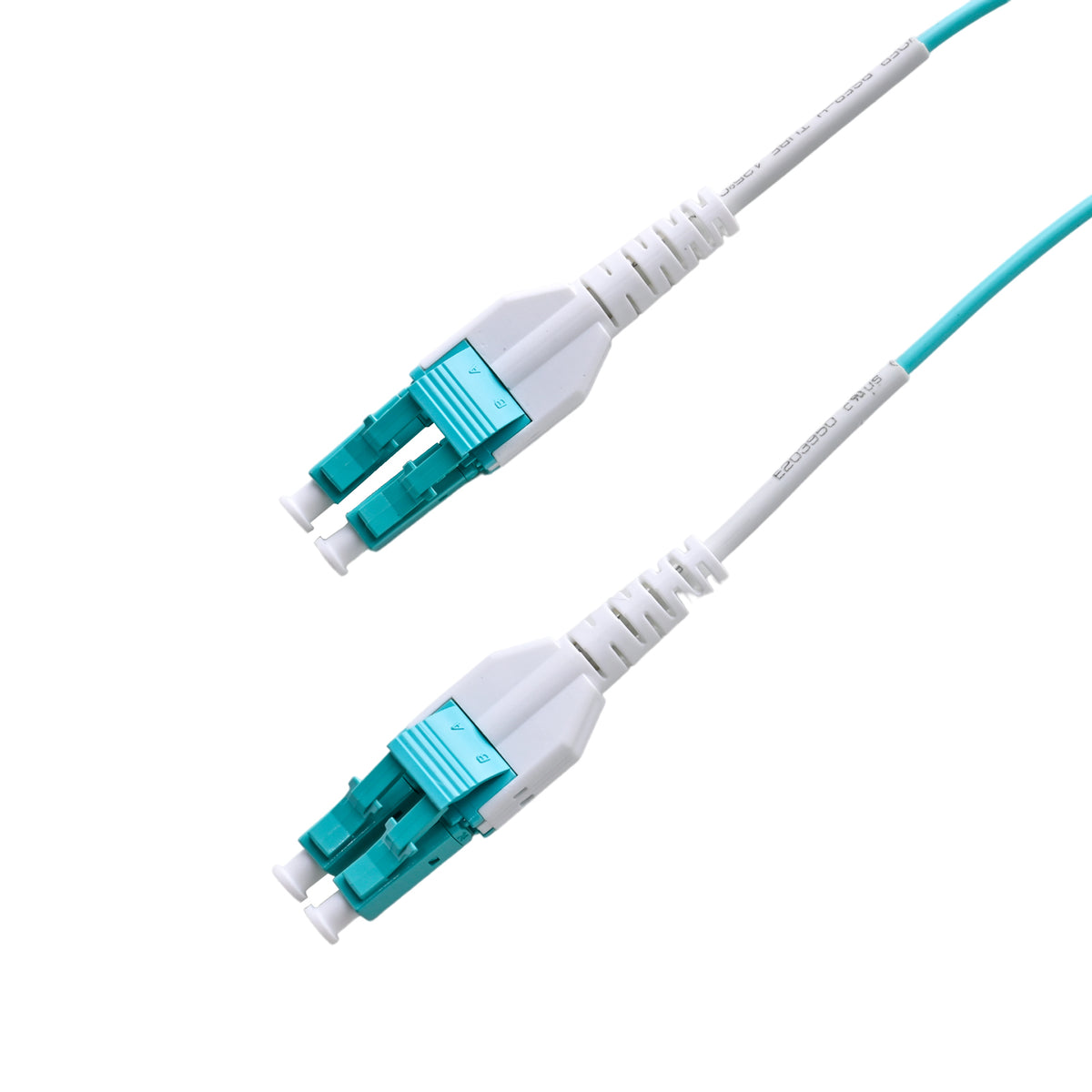
One Cable Instead of Two
Traditional duplex zipcords route two fibers side by side, each with its own boot. The uniboot design merges them into one round cable and one boot. Each port gets a single, slim cord. That makes it much easier to see and trace connections in a crowded rack.
OM3 Capabilities
OM3 carries 2,000 MHz·km of effective modal bandwidth at 850 nm. Under IEEE 802.3, 10GBASE-SR runs up to 300 meters on it, and 25GBASE-SR up to 70 meters. For most enterprise links, that's ample performance at a lower cost than OM4.
Better Airflow
Switches and servers pull cooling air through the front of the rack. Thick bundles of zipcord can block that path. Slimmer uniboot cords leave more open space, which helps equipment run cooler.
Easier Moves and Changes
With fewer, thinner cables at each port, technicians can grab the right cord quickly. The round jacket doesn't snag the way flat zipcords sometimes do. Changes take less time and carry less risk of bumping live links.
Matching OM3 Plants
Use this cord on OM3 backbones to keep link performance predictable. It also mates cleanly with OM4 hardware, since both use a 50 µm core. Avoid connecting it to orange 62.5 µm OM1 fiber.
A 10G Loss Budget on OM3
IEEE allows 2.6 dB of total channel loss for 10GBASE-SR on a 300-meter OM3 link. Each mated LC pair uses part of that. Clean, factory-polished uniboot connectors help keep the total well within the limit.