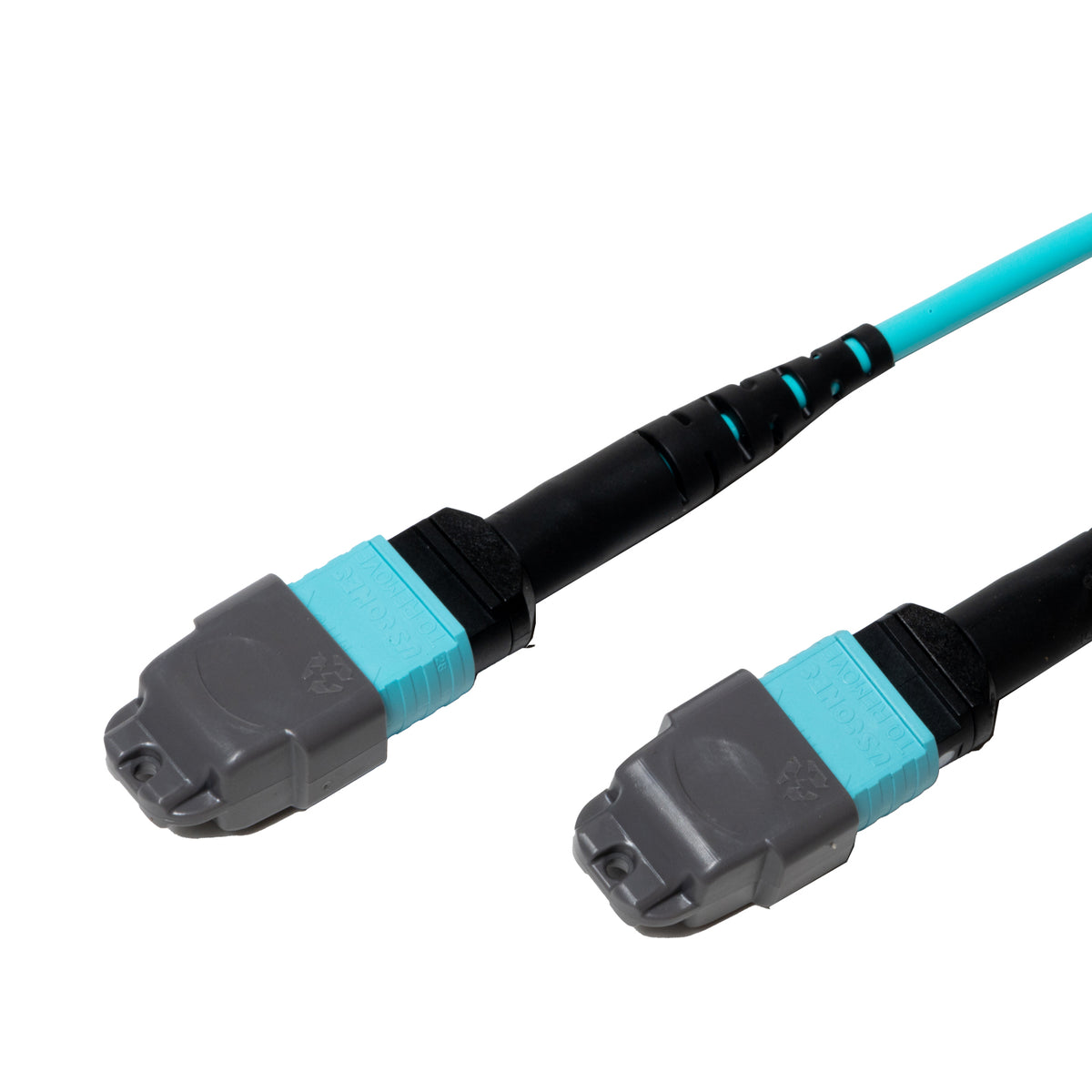
Straight-Through Type A Mapping
Type A trunks are key-up on one end and key-down on the other. Fiber 1 lands on fiber 1, and fiber 12 lands on fiber 12. Nothing crosses inside the cable itself. The transmit-to-receive flip happens later, usually with an A-to-B duplex patch cord at the panel. Many installers like it for that reason. The polarity logic stays simple and easy to document.
Built for Cassette-Based Systems
Most Type A trunks end up between two MTP-to-LC cassettes. One trunk replaces six duplex runs, and the cassettes break it back out into standard LC ports. Moves and changes happen at the front of the panel. The trunk stays put in the tray, safe from daily handling.
Elite Connectors Save Your Loss Budget
Standard MPO connectors can add around 0.6 dB per connection. Elite MTP connectors cut that roughly in half. On a channel with two cassettes and a few patch cords, those savings add up fast. They can be the difference between a clean link and one that throws errors under load.
OM4 Reach and Speed
OM4 fiber has a 50/125 µm core with high modal bandwidth at 850 nm. It carries 10G up to about 400 meters, 40G SR4 up to about 150 meters, and 100G SR4 up to about 100 meters. That covers nearly every link inside a typical data hall.
Plenum-Rated OFNP Jacket
OFNP is the highest fire rating for indoor optical cable. It passes the NFPA 262 flame and smoke test, so inspectors accept it in air-handling spaces. You also avoid the cost of extra conduit in ceilings and floors.
Handling Tips
Keep the dust caps on until the moment you connect. Clean both ends with a one-click MTP cleaner before mating. Pull by the trunk body, never by the connector, and respect the bend radius printed on the spec sheet.
Where It Fits Best
This trunk shines in enterprise server rooms, colocation cages, and main distribution areas that feed rows of cabinets. It also works well in campus buildings where one telecom room serves a whole floor. Anywhere a cassette-based fiber plant makes sense, the Type A OM4 trunk slots right in.