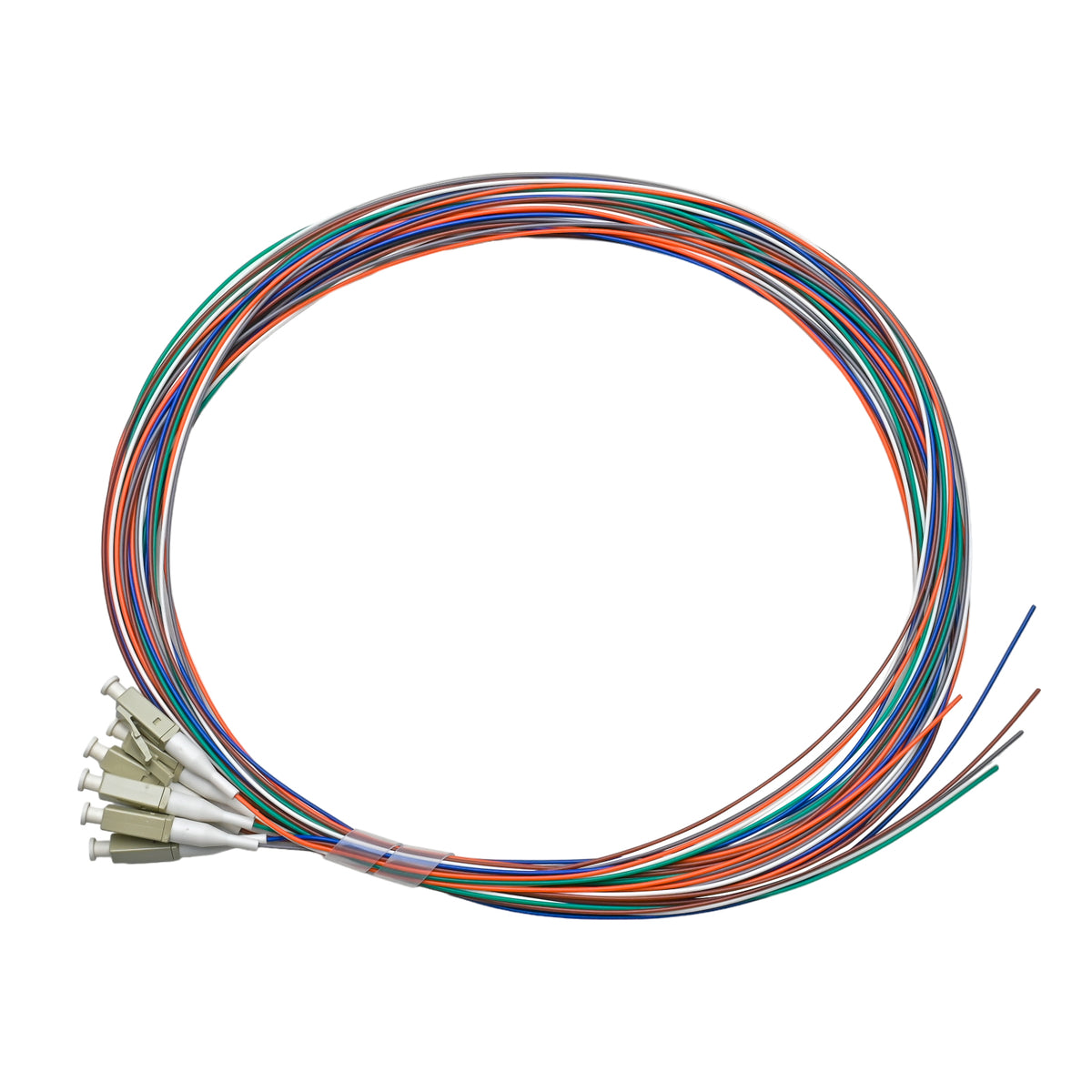
Semi-Tight Buffer Benefits
A semi-tight buffer leaves a microscopic gap around the coated fiber, with nothing inside. Even under 100x magnification, that gap stays invisible. In practice, one circular cut removes 10 cm or more of buffer. Less stripping means faster splicing and fewer chances to scratch the glass.
OM3 Reach for Everyday Links
At 850 nm, OM3 is rated for 2,000 MHz·km of effective modal bandwidth. It carries 10GBASE-SR to 300 meters and 25GBASE-SR to 70 meters. For closets, server rooms, and short backbones, that's ample performance at a lower cost than OM4.
LC Panels Save Space
LC connectors use a 1.25 mm ferrule, half the size of SC. More ports fit in each panel, and patching to SFP-based switches needs only standard LC duplex cords. That cuts down on adapters and mated pairs.
Three Duplex Pairs
Group the strands as blue-orange, green-brown, and slate-white. Use the same pairing at the far end of the backbone. Polarity stays consistent, and troubleshooting stays simple.
25G on OM3: The Budget
IEEE allows about 1.8 dB of total channel loss for 25GBASE-SR on a 70-meter OM3 link. That's tight, so every connector and splice counts. Factory-polished LC ends and careful fusion splices help you stay within it.
Matching Optics
These pigtails pair naturally with 10GBASE-SR SFP+ and 25GBASE-SR SFP28 transceivers through LC duplex patch cords. Check that both ends of each link use multimode optics rated for 850 nm.