Built for Volume
On projects with dozens of 12-fiber cables, stripping time adds up quickly. The semi-tight buffer comes off in one long section with no gel to clean. Crews finish each tray faster, and the bare fiber gets handled less.
Laser-Optimized Glass
OM3 is manufactured with a carefully controlled graded-index profile. It's checked by differential mode delay testing, which earns its 2,000 MHz·km rating at 850 nm. That precision lets VCSEL optics run 10G across a full building.
Twelve Colors, Six Pairs
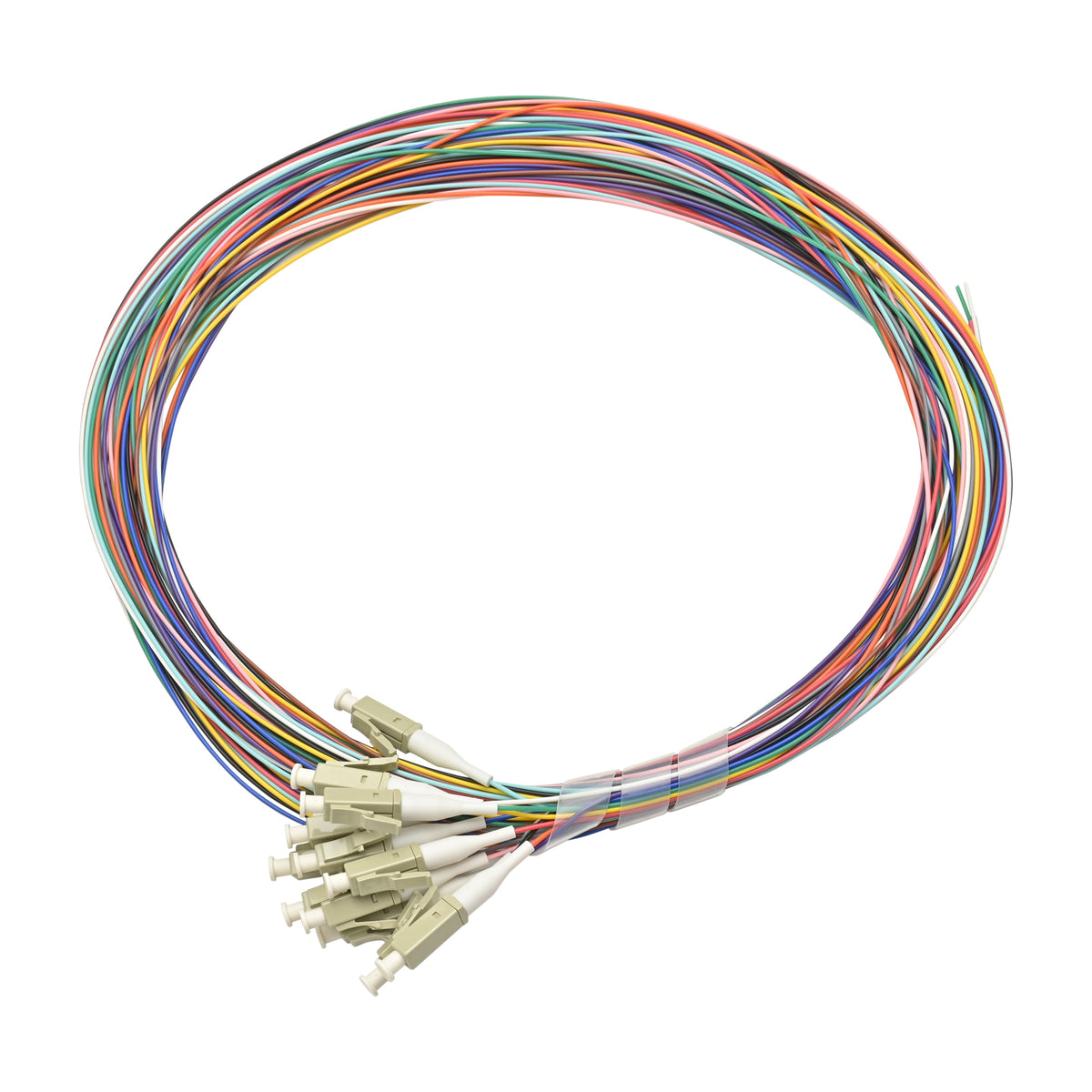
The fibers follow TIA-598: blue, orange, green, brown, slate, white, red, black, yellow, violet, rose, and aqua. Pair neighbors to form six duplex circuits. Match that plan at the other end to keep polarity correct.
Fits Within the 50 µm Family
OM3 splices cleanly to OM4 and OM5, since all three share a 50 µm core. A mixed link runs at the lowest grade's performance. If your backbone is OM3, these pigtails match it exactly.
Measuring the Finished Link
After splicing, test each fiber at 850 nm and 1300 nm with a light source and power meter. An OTDR trace shows individual splice losses if any reading looks high. Save every result by port number.
Planning Splice Counts
Each 12-strand cable needs twelve splices and twelve protection sleeves. Most rack-mount trays hold 12 or 24 splices. Count trays before the job starts, so crews aren't waiting on parts halfway through a build.