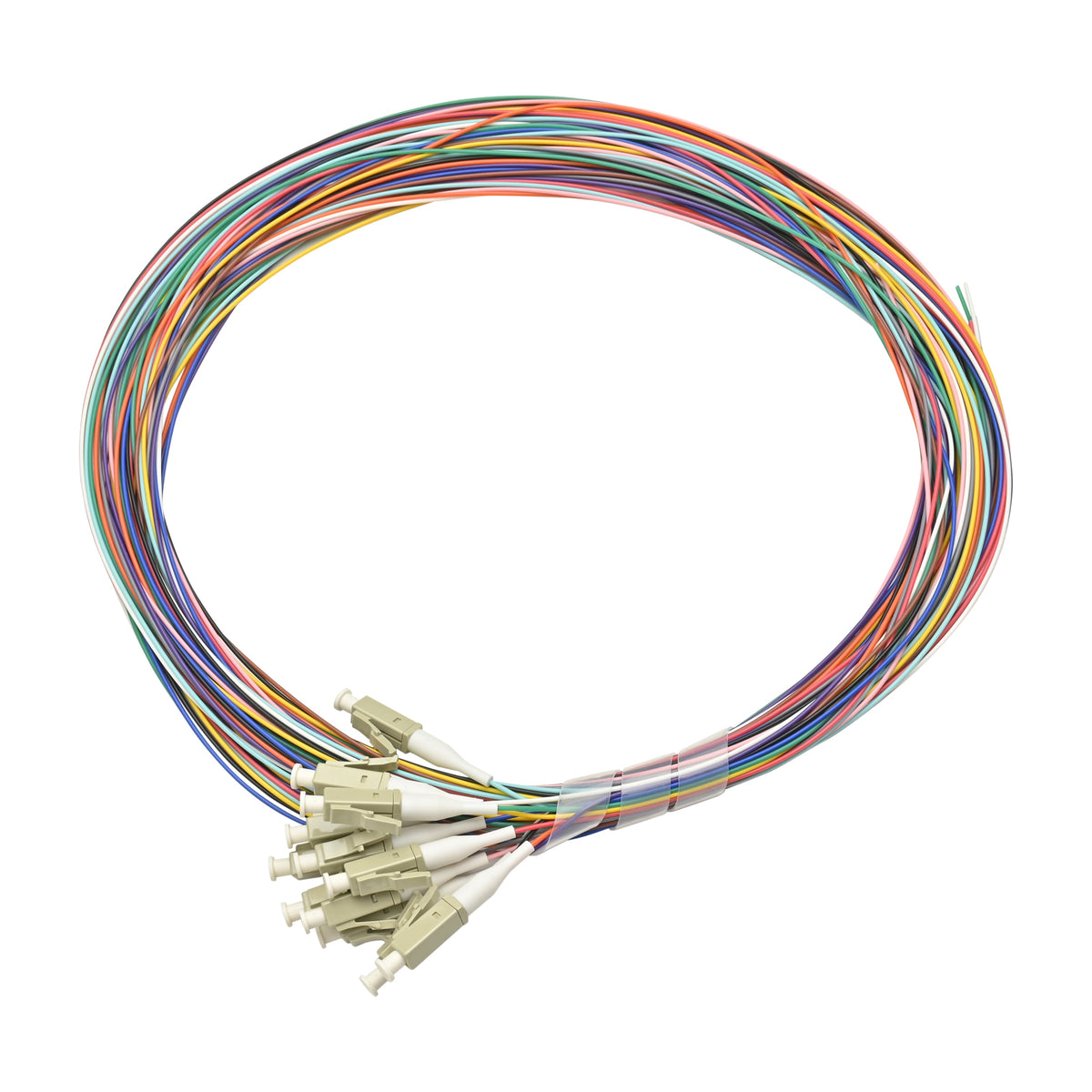
Six Duplex Circuits From One Cable
Twelve fibers terminate as six LC duplex pairs. In a typical 1U panel, that leaves plenty of room for more cables. Pair the strands in TIA-598 order: blue and orange, green and brown, slate and white, red and black, yellow and violet, and rose and aqua.
OM3 Performance Figures
OM3 provides 2,000 MHz·km of effective modal bandwidth at 850 nm. It runs 10GBASE-SR to 300 meters, 40GBASE-SR4 to 100 meters, and 100GBASE-SR4 to 70 meters. TIA-568 caps cabled attenuation at 3.5 dB/km at 850 nm.
Tight Buffer for Busy Panels
The tight 900 µm buffer gives every strand stiffness and crush resistance. When twelve pigtails share one tray, that firmness helps keep fibers from kinking as they're dressed and moved. It strips in short passes with a precision tool.
LC Interface Details
Each LC connector uses a 1.25 mm ceramic ferrule and a latch that clicks into place. The design follows IEC 61754-20. Because SFP-family transceivers use LC, there's no need for hybrid patch cords at the switch.
Upgrade Options on OM3
40G BiDi optics can run up to about 100 meters over a single OM3 duplex pair. 100G SWDM4 reaches about 75 meters. Those options let OM3 plants handle more traffic without new cable.
Labeling and Records
Label each LC port with the panel, port number, and the far-end location, following ANSI/TIA-606. Store test results alongside the labels. Clear records turn a two-hour trace into a five-minute fix when something goes wrong later.