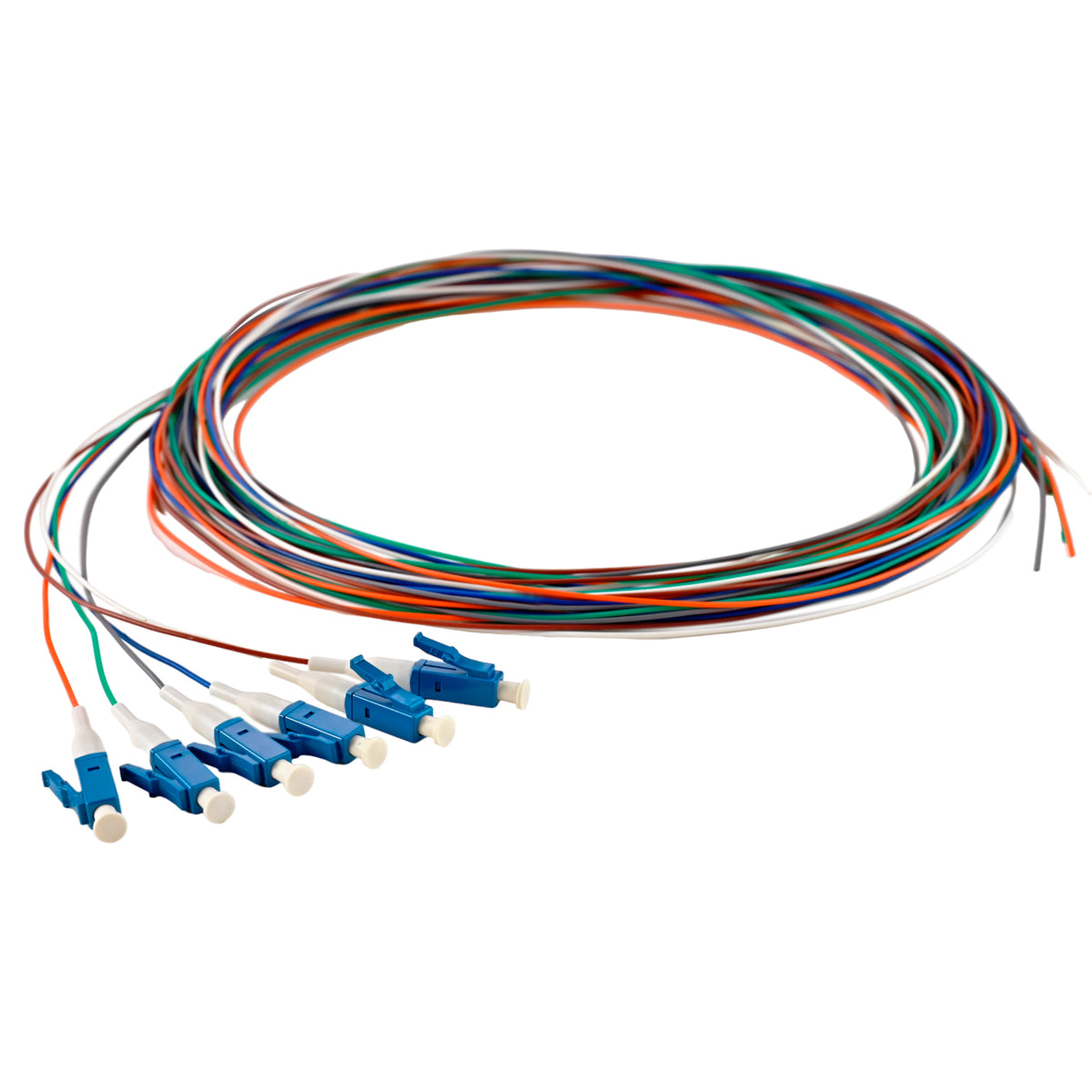
LC Is the Single-Mode Standard
Nearly every single-mode SFP, SFP+, SFP28, and QSFP LR optic uses a duplex LC port. Terminating your backbone on LC lets you patch directly to those optics with standard LC jumpers. You avoid hybrid cords and extra mated pairs.
A 10G Long-Reach Budget
10GBASE-LR runs up to 10 km on OS2 with a channel budget of about 6.2 dB. A 5 km run at 0.4 dB/km uses about 2 dB. Two connector pairs and two splices add maybe another 1 to 1.5 dB. That leaves a comfortable safety margin for repairs and aging.
Bend-Insensitive Glass
ITU-T rates G.657.A1 glass for bends as tight as a 10 mm radius. It matches G.652.D in mode field diameter, so splices stay low-loss. That combination suits tight LC cassettes and crowded trays.
Tight Buffer Durability
A 900 µm tight buffer adds stiffness and crush resistance to each strand. It holds up well in enclosures that are opened often for moves, adds, and changes.
Three Single-Mode Pairs
Match blue to orange, green to brown, and slate to white as pairs. Keep that pairing at both ends so transmit and receive line up through every link.
Carrier Hand-Offs
Service providers often deliver single-mode circuits on a few strands at a building entrance. Six LC pigtails let you terminate the incoming cable in a small panel. From there, short LC patch cords connect directly to your routers or switches.